
Why Granite Slabs Have Uneven Gloss After Polishing (Root Causes & Fixes)
Uneven gloss on granite slabs is one of the most common quality problems in slab production. It usually shows up as dull zones, patchy reflection, streaks, or “cloudy” areas—even when the slab looks flat. The good news: most cases can be solved by checking a few key variables in the polishing process.
.jpg)
This guide explains the root causes of uneven gloss and gives you a practical troubleshooting checklist you can use on-site.
What “Uneven Gloss” Looks Like (Typical Symptoms)
- Patchy shine: some areas glossy, other areas matte
- Streaks or bands: gloss changes along the feeding direction
- Edge vs center difference: edges shine more (or less) than the middle
- Head-to-head marks: repeating patterns that match polishing head spacing
Before changing settings, confirm the problem under consistent lighting (same angle, same lamp, clean dry slab surface). Water film and slurry residue can hide or exaggerate gloss differences.
Root Cause 1: Abrasive Sequence Is Not Matched to Granite Hardness
Granite hardness and crystal structure vary a lot. If the abrasive sequence jumps too quickly (or repeats the wrong grit), some zones will not be properly refined and will stay dull even after final polishing.
Fix
- Confirm the abrasive sequence is complete (no missing transition grit).
- For harder granite, increase time/pressure on mid-grits rather than forcing the final stage.
- Replace “mixed-wear” abrasives (some segments worn faster than others).
Root Cause 2: Uneven Pressure Between Heads (or Across the Same Head)
Uneven head pressure is one of the fastest ways to create patchy gloss—especially on continuous polishing lines. If pressure differs across the slab width, you’ll often see dull stripes.
Fix
- Check head pressure settings and verify actual pressure output (not only panel values).
- Inspect lifting mechanisms and guide parts for sticking, leakage, or slow response.
- Calibrate to keep pressure consistent from left to right and head to head.
Root Cause 3: Feed Speed Too High (or Not Stable)
If belt transfer speed is too high, abrasives don’t have enough contact time to refine the surface. If the speed fluctuates, gloss will fluctuate with it.
Fix
- Reduce belt speed for difficult granite or thicker slabs.
- Confirm the conveyor is stable, aligned, and not slipping under load.
- Make sure parameter changes are recorded so you can compare results by batch.
Root Cause 4: Water Flow, Slurry, and Contamination Problems
Polishing depends on stable cooling and clean contact. Too little water causes overheating and micro-burn marks; too much slurry (or dirty water) reduces cutting efficiency and creates cloudy patches.
Fix
- Verify water flow reaches every head evenly (no clogged nozzles).
- Improve slurry removal to keep abrasives cutting cleanly.
- Use filtration/settling to reduce recycled-water contamination.
Root Cause 5: Slab Not Flat / Thickness Variation
If the slab enters polishing with thickness variation or warp, some heads will “float” while others overload, creating uneven refinement and uneven gloss.
Fix
- Check calibration and slab thickness consistency before polishing.
- Improve upstream cutting accuracy and handling to reduce warping.
- Ensure stable support on the conveyor and correct slab positioning.
Root Cause 6: Final Buff/Polish Stage Is Not Actually Finishing
Many factories try to fix uneven gloss by increasing the final polish stage only. But if earlier grits did not do their job, final polishing cannot “save” the surface.
Fix
- Locate the stage where gloss becomes uneven (test after several key heads).
- Adjust mid-stage parameters first; then fine-tune the final stage.
- Standardize a proven process sheet for each granite type.
On-Site Troubleshooting Checklist (Fast Diagnosis)
- Clean & dry the slab and check under consistent lighting.
- Mark dull zones (edge/center, left/right, repeated patterns).
- Check head pressure consistency across the width and between heads.
- Confirm abrasive condition: wear uniformity, correct grit order, correct type for granite.
- Verify belt transfer speed stability and reduce speed for hard granite if needed.
- Inspect water & slurry: flow to each head, nozzle clogging, recycled water cleanliness.
- Check slab flatness/thickness entering the line.
- Run a controlled test (change only 1 variable at a time, record the result).
Recommended Equipment: Shuinan Automatic Line Polishing Machine (SNMJ Series)
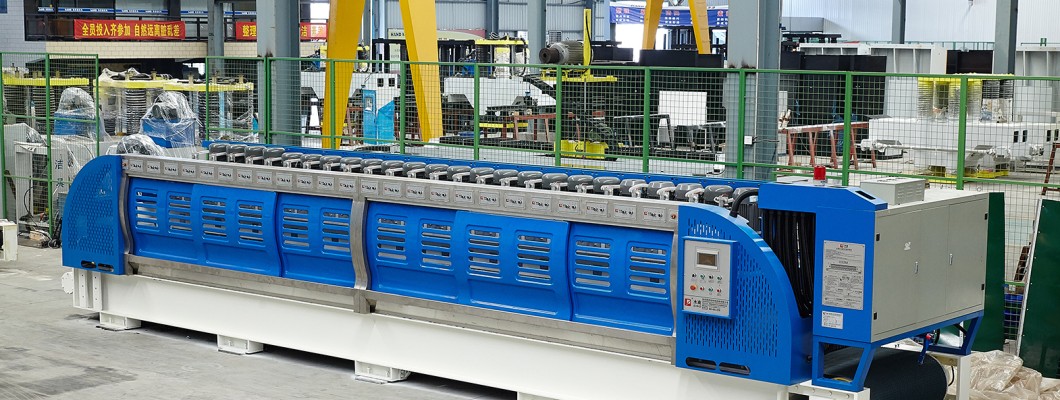
To keep gloss consistent, you need stable motion control, reliable sensing, and repeatable polishing parameters. Shuinan Machinery offers an Automatic Line Polishing Machine with models: SNMJ-16C, SNMJ-20C, and SNMJ-24C.
Key Features (from our product details)
- Double cylinder driving for grinding head movements.
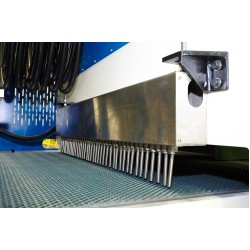
- Non-contact sensor for automatic detection of slab/plate shape.
- Centralized oil supply with automatic lubrication and alert function.
- Uses well-known components, including Japan Mitsubishi PLC, Japan Yaskawa inverter, and Taiwan Shihlin electrical components (switch/contactor).
- 8–24 polishing heads option; single beam polishing structure.
Main Technical Specifications (Standard Models)
| Item | Unit | SNMJ-16C | SNMJ-20C | SNMJ-24C |
|---|---|---|---|---|
| Quantity of polishing head | pcs | 16 | 20 | 24 |
| Useful working width | mm | 400–1200 | 400–1200 | 400–1200 |
| Useful working thickness | mm | 10–50 | 10–50 | 10–50 |
| Belt transfer speed | mm/min | 0–4000 | 0–4000 | 0–4000 |
| Water consumption | m³/h | 21 | 23 | 25 |
| Power of spindle motor | kW | 7.5×12 + 9×4 | 7.5×16 + 9×4 | 7.5×20 + 9×4 |
| Total power | kW | 138 | 168 | 198 |
| Overall dimension (L×W×H) | mm | 9200×2150×2200 | 10200×2150×2200 | 11400×2150×2200 |
| Approximate weight | kg | 19000 | 21000 | 22500 |
Note: standard specs are based on standard models; polishing width can be customized if you have special requirements.
About Shuinan Machinery Factory
Shuinan (Quanzhou Hiende Mechanical and Electrical Technology Development Co., Ltd., formerly Fujian Shuinan Stone Machinery Co., Ltd.) was founded in 1997 and has built a strong reputation in domestic and international stone machinery manufacturing.
- Located in Shuitou, known as the Chinese stone capital.
- Factory area: 60,000 m², with advanced processing equipment, warehousing and logistics systems, and assembly production lines.
- Team: 300+ professionals across R&D, production, sales, and service.
- Certifications: ISO9001:2015, CE safety certification, and TUV certification.
- Annual production capacity: 3000 units/sets; exported to 30+ countries.
Need Help Fixing Uneven Gloss? We Can Recommend a Process Sheet
If you tell us your granite type, slab thickness, target gloss level, and your current abrasive sequence, we can help you identify the most likely cause and recommend practical parameter adjustments (pressure, speed, water, and sequence).
Leave a Comment