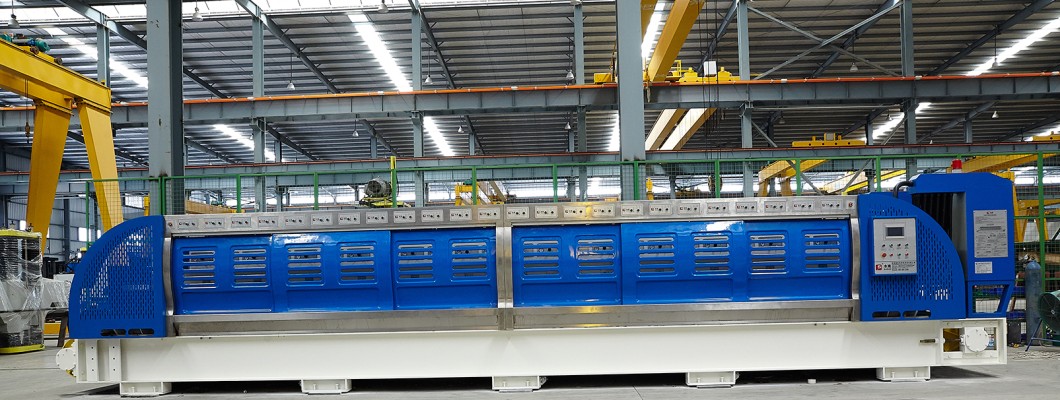
How Many Polishing Heads Does Your Stone Factory Need: 16, 20 or 24?
Today, I would like to talk about a question that many stone factory owners ask before purchasing an automatic polishing line: should the machine have 16, 20 or 24 polishing heads?
It may seem that a machine with more polishing heads must always be the better choice. However, the correct configuration depends on much more than the number of heads. Your stone type, slab condition, required finish, production target, abrasive sequence, available factory space and investment budget all need to be considered.
This guide explains the practical differences among 16-head, 20-head and 24-head stone polishing machines and helps you select a suitable configuration for your production line.
What Does the Number of Polishing Heads Mean?
On an automatic stone polishing machine, slabs move continuously along a conveyor while a series of polishing heads performs different grinding and polishing stages. The first heads normally carry coarser abrasives to remove surface irregularities. The following heads use progressively finer abrasives to refine the surface, and the final heads develop the required gloss.
More polishing heads provide more working stations along the line. This gives the factory greater flexibility to:
- Arrange a more complete abrasive sequence.
- Distribute the grinding load across more heads.
- Reduce the amount of material each individual head must remove.
- Maintain surface quality at a higher conveyor speed when conditions permit.
- Process difficult or inconsistent slabs with greater stability.
However, adding heads also increases the machine length, connected power, number of abrasives in use, maintenance requirements and initial investment. Therefore, the objective is not to buy the largest number possible, but to match the configuration to the actual production requirement.
Quick Comparison: 16, 20 and 24 Polishing Heads
| Configuration | Best Suited For | Main Advantages | Points to Consider |
|---|---|---|---|
| 16 Heads | Small and medium factories with moderate output | Lower investment, smaller footprint and simpler operation | Less flexibility for long abrasive sequences and high-speed production |
| 20 Heads | Factories requiring a balance of output, quality and cost | Flexible abrasive arrangement and good production capacity | Requires a larger budget and working area than a 16-head line |
| 24 Heads | Large factories, demanding materials and continuous high-volume production | More processing stages, greater flexibility and higher output potential | Higher investment, energy demand, abrasive inventory and maintenance workload |
Important: This table is a general selection guide. The actual performance of any polishing line depends on its mechanical design, head power, conveyor system, control system, abrasive type and operating parameters.
When Is a 16-Head Polishing Machine Enough?
A 16-head automatic polishing machine is often suitable for a factory that has a moderate production target and mainly processes slabs with relatively stable surface conditions. It can complete the normal grinding and polishing sequence while keeping the initial investment and factory-space requirement under control.
A 16-head configuration may be a practical choice when:
- Your factory has a small or medium production volume.
- The incoming slabs are already reasonably flat.
- You process a limited range of familiar stone materials.
- The required conveyor speed is moderate.
- Your priority is controlling the initial investment.
- Your factory has limited installation space.
The main limitation is that fewer heads must perform the complete grinding and polishing process. If the slab surface is uneven or the stone requires a longer abrasive sequence, the conveyor may need to run more slowly to achieve the required finish.
Why Is a 20-Head Polishing Machine a Popular Balanced Choice?
For many established stone factories, a 20-head polishing machine provides a practical balance among production capacity, polishing quality, flexibility and investment. Compared with a 16-head machine, four additional heads allow the operator to distribute the abrasive stages more effectively.
A 20-head configuration is worth considering when:
- Your factory operates regularly rather than only handling occasional orders.
- You need stable polishing quality across different batches of granite.
- You want additional abrasive stages without moving to the largest machine.
- You expect production demand to increase in the future.
- You want a balance between purchasing cost and long-term productivity.
Shuinan Machinery offers automatic slab polishing solutions including 20-head configurations. Depending on the selected model, a polishing width of up to 1,200 mm and a slab thickness range of approximately 15–50 mm can be available. Final specifications should always be confirmed according to the material and production requirement.
When Should You Choose a 24-Head Polishing Machine?
A 24-head polishing machine is designed for factories that need more processing stages, higher continuous output potential or greater control over difficult polishing conditions. The additional heads can be used to strengthen the calibration and grinding stages, extend the fine-polishing sequence, or distribute work more evenly across the line.
A 24-head configuration may be suitable when:
- Your factory has a high and stable daily production requirement.
- The line is expected to operate for long shifts.
- You process hard granite or materials that require more polishing stages.
- Incoming slabs vary in flatness or surface condition.
- Consistent gloss is required across large orders.
- The factory has enough space, electrical capacity and budget.
A 24-head line should not be selected only because it is larger. If the production volume is low, some heads may be underused, while the factory still bears the additional costs of abrasives, electricity, maintenance and floor space.
Six Factors That Should Determine Your Choice
1. Required Production Capacity
Start with the number of square meters that the factory needs to polish per shift or per day. More heads can support a higher conveyor speed, but only when the stone, abrasives, head pressure, water supply and machine settings are properly matched.
Do not estimate output from the number of heads alone. A slower 24-head line with unsuitable abrasives may produce less acceptable material than a correctly configured 20-head line.
2. Stone Type and Hardness
Granite varieties do not all behave the same during polishing. Mineral composition, grain structure, hardness and surface defects affect how quickly grinding marks can be removed and how easily gloss develops. Hard or difficult granite may benefit from additional grinding and fine-polishing stages.
If the factory processes several stone varieties, the machine should provide enough heads to create flexible abrasive sequences for the different materials.
3. Initial Slab Flatness
Slabs with saw marks, thickness variation or an uneven surface require more work in the early grinding stages. In this situation, some heads must be dedicated to surface correction before fine polishing begins.
When the slabs are already well calibrated and flat, the polishing line can devote more heads to surface refinement and gloss development. This is why the upstream cutting and calibration quality directly affects polishing efficiency.
4. Required Surface Finish and Gloss
Standard construction slabs and premium decorative slabs may have different acceptance standards. A customer demanding a highly consistent mirror finish may require a longer and more carefully arranged abrasive sequence than a project accepting a normal commercial finish.
The correct number of heads should therefore be selected according to the required final product, not only the raw material.
5. Abrasive Sequence
Every polishing head must be assigned a specific abrasive grit or processing function. The required sequence depends on the abrasive supplier, stone type and incoming slab surface. Skipping too many grit stages can leave scratches that finer abrasives cannot remove efficiently.
Before ordering the machine, discuss the intended abrasive sequence with both the machine manufacturer and abrasive supplier. This helps determine whether 16 heads are sufficient or whether 20 or 24 heads will provide a more reliable process.
6. Budget, Space and Supporting Utilities
The purchase price is only one part of the investment. The factory should also consider:
- Machine installation length and loading space.
- Electrical capacity and local voltage.
- Cooling-water supply and water-recycling system.
- Number and cost of abrasives installed on the machine.
- Routine maintenance and spare-parts inventory.
- Conveyors and slab-handling equipment before and after the line.
A larger polishing machine only creates value when the rest of the factory can continuously supply and remove slabs without causing production bottlenecks.
More Heads Do Not Automatically Guarantee Better Gloss
Poor polishing quality is not always caused by an insufficient number of heads. Even a 24-head machine can produce an uneven or low-gloss surface when other conditions are incorrect.
Common causes include:
- Incorrect abrasive selection or grit sequence.
- Worn or unevenly consumed abrasives.
- Excessive conveyor speed.
- Incorrect head pressure.
- Insufficient cooling water or blocked water nozzles.
- Uneven slab thickness or poor initial flatness.
- Improper conveyor calibration.
- Mechanical vibration or poorly maintained polishing heads.
Machine configuration, abrasives and operating parameters must work as one complete system.
A Simple Selection Guide
- Choose 16 heads when production is moderate, slabs are relatively consistent, space is limited and investment control is the priority.
- Choose 20 heads when you need a balanced solution for regular production, flexible abrasive arrangements and future growth.
- Choose 24 heads when the factory has high-volume continuous orders, difficult materials or demanding surface-quality requirements.
If you are unsure, provide the machine supplier with your stone type, slab width and thickness, current surface condition, target gloss, expected square meters per day, working hours and local power supply. These details are more useful than simply requesting the largest model.
Frequently Asked Questions
Does a 24-head polishing machine always polish faster than a 20-head machine?
Not always. It has greater processing potential, but actual speed depends on the stone, abrasive sequence, grinding pressure, water supply, incoming slab quality and required finish.
Can a small factory use a 24-head machine?
Yes, but it may not be economical if the factory cannot provide enough slabs to keep the line operating efficiently. Available space, power capacity and future production plans should also be considered.
Can one polishing machine process different types of granite?
Yes. However, conveyor speed, head pressure, water flow and abrasive configuration may need to be changed for different granite varieties.
Is a 16-head machine suitable for high-gloss granite?
It can produce a high-gloss surface when the slabs are in good condition and the abrasive sequence and operating parameters are correct. The production speed may need to be reduced for more demanding materials or finishes.
Should production capacity be calculated only from the number of heads?
No. Reliable output calculations must also include slab dimensions, conveyor speed, operating hours, loading gaps, stone properties, abrasive changes, maintenance time and the percentage of slabs that meet the required quality standard.
Conclusion
The right polishing machine is the one that matches the entire factory, not simply the one with the most heads. A 16-head machine can be economical and effective for moderate production, a 20-head machine offers a strong balance for many established factories, and a 24-head machine provides additional flexibility for high-volume or demanding production.
Before making a decision, compare your actual production target, stone characteristics, slab condition, required finish, factory space and total operating cost. A properly selected and correctly operated machine will usually provide more value than an oversized line that is not fully utilized.
About Shuinan Machinery
Founded in 1997, Shuinan Machinery is a professional manufacturer of stone mining and processing equipment in Shuitou, Fujian, China. Our product range includes multi-blade block cutting machines, bridge cutting machines, automatic slab polishing machines, quarry machines and other stone-processing solutions.
Tell us your stone type, slab dimensions, required output and factory conditions. Our team will help you select a suitable polishing-machine configuration for your production line.
Website: https://shuinanmachinery.com/
Email: [email protected]
WhatsApp: +86 198 0595 5837
Related Products
Leave a Comment